
Here is your deep-dive, authority-level, long-form blog post with fully expanded subpoints, strategic depth, and execution clarity. This is designed to position you as a serious industry thinker, not just a content writer.
Language learning is no longer an education niche — it is becoming a global infrastructure layer driven by AI.
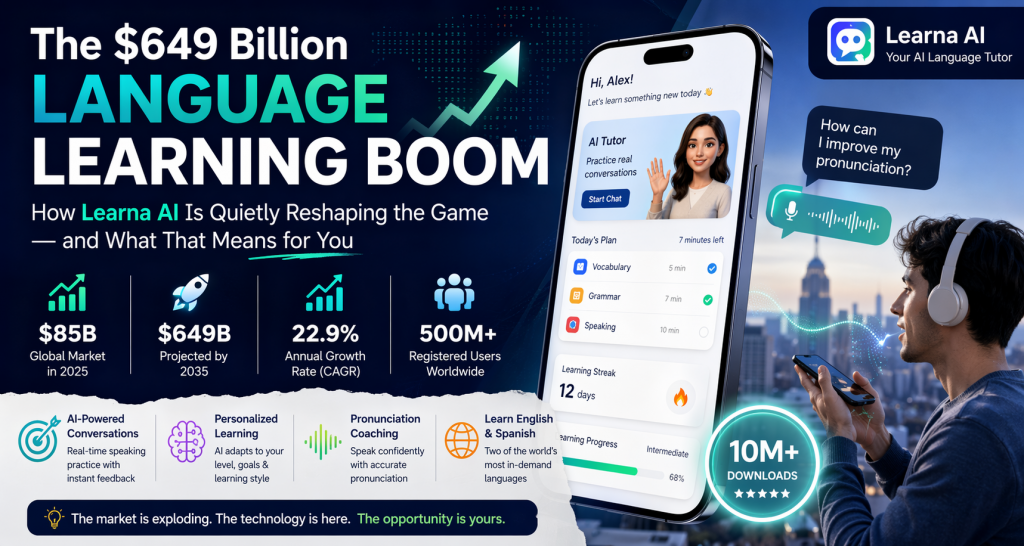
Market Expansion Dynamics
- $85B market (2025) → projected $649B by 2035
- 22–23% CAGR, significantly above average tech sectors
- 500M+ active learners globally
What’s Driving This Growth?
1. AI Has Removed Cost Barriers
Traditionally:
- Tutors = expensive ($10–$50/hour)
- Classes = fixed schedules
Now:
- AI tutors operate at near-zero marginal cost
- Infinite scalability
👉 This shifts language learning from premium service → mass utility
2. Time Flexibility Has Changed Behavior
Modern users prefer:
- Micro-learning (5–15 min sessions)
- On-demand access
👉 This aligns perfectly with mobile-first AI apps like Learna AI
3. Economic Incentives Are Stronger Than Ever
Language learning is now tied directly to:
- Remote work
- Freelancing (Upwork, Fiverr)
- Migration
- Global hiring
👉 This creates high-intent, high-paying users
App Breakdown: What Learna AI Gets Right
1. AI-First Interaction Model
Unlike traditional apps, Learna focuses on:
- Real-time conversations
- Adaptive responses
- Interactive speaking
Why this works:
- Mimics real-world communication
- Reduces passive learning
- Increases engagement
2. Rapid User Acquisition Strategy
Learna’s growth is not accidental.
Aggressive Ad Testing
- Thousands of creatives across platforms
- Continuous A/B testing
Funnel Optimization
- Immediate onboarding
- Fast engagement loops
👉 This creates high install velocity
3. Psychological Design (Addiction Mechanics)
Learna leverages:
- Instant feedback loops
- Progress indicators
- AI interaction novelty
Result:
- High initial engagement
- Strong short-term retention
Where Learna AI Breaks (Critical Weaknesses)
This is where your opportunity becomes real.
1. Pronunciation System Failure (Deep Technical Issue)
Root Problem
Most AI systems:
- Use probabilistic matching
- Lack detailed phonetic analysis
What Users Experience
- Incorrect pronunciation marked correct
- No clear correction guidance
Why This Matters
Language learning depends on:
👉 Accurate feedback loops
Without it:
- Users build false confidence
- Real-world performance collapses
Opportunity Layer
You can outperform by implementing:
- Phoneme-level scoring
- Stress & intonation detection
- Real-time correction feedback
👉 This alone can create a premium product segment
2. Curriculum Weakness (Instructional Design Gap)
What Learna Lacks
- Structured progression (Beginner → Advanced)
- Reinforcement cycles
- Context-based learning
Why This Happens
Tech-first companies often:
👉 Prioritize features over pedagogy
What a Winning Curriculum Looks Like
A strong system includes:
- Concept Introduction
- Clear explanation
- Examples
- Guided Practice
- Controlled exercises
- Applied Learning
- Real-world scenarios
- Reinforcement
- Spaced repetition
Opportunity
👉 Combine AI with professional curriculum design
This is:
- Hard to copy
- Highly valuable
- Rare in current apps
3. Monetization Friction (Conversion Mistake)
Current Approach
- Early paywall
- Limited free experience
Why It Fails
Users need:
- Trust
- Progress
- Emotional investment
Before paying
Better Monetization Funnel
- Free → Habit formation
- Progress → Visible improvement
- Paywall → Unlock transformation
👉 This increases:
- Conversion rate
- Retention
- Lifetime value

The Real Opportunities (Expanded)
1. Emerging Market Domination
Market Reality
Countries like:
- Pakistan
- India
- Bangladesh
Have:
- Huge demand
- Low competition (localized apps)
Execution Strategy
Localization Layers:
- Language UI (Urdu, Hindi)
- Cultural examples
- Local pricing
Payment Optimization:
- Weekly plans
- Mobile wallets
👉 This creates a mass adoption engine
2. Career-Focused English (High-Intent Users)
Why This Segment Wins
Users here:
- Have urgent needs
- Have measurable goals
- Are willing to pay
Product Features
- AI job interview simulator
- Client communication practice
- Workplace conversation scenarios
👉 Focus on outcomes, not lessons
3. Pronunciation Coaching (Premium Niche)
Current Market Gap
Apps like:
- Elsa Speak
Focus only on pronunciation — and succeed.
Advanced Opportunity
Build:
- Accent-specific training
- Voice waveform comparison
- Real-time corrections
👉 This is:
- Highly defensible
- High pricing potential
4. Culture + Communication Layer
Language ≠ words
Language = context + tone + behavior
Missing Elements
- Professional tone
- Social nuance
- Cultural expectations
Product Idea
Teach scenarios like:
- Office meetings
- Client negotiations
- Networking conversations
👉 This transforms your product into a life skill platform
Execution Playbook (Detailed)
Step 1 — Audience Engine
Why It Matters
Audience = distribution + validation
Content Strategy
Create:
- App comparisons
- Learning mistakes
- Speaking tips
Outcome
- Organic traffic
- User insights
- Early monetization
Step 2 — Niche Selection Framework
Evaluate based on:
- Pain level
- Market size
- Competition
- Monetization potential
Example
Best niche:
👉 “AI English coach for Pakistani freelancers”
Step 3 — MVP Build Strategy
Key Principle
👉 Build less, validate more
MVP Focus
- One feature
- One outcome
- One user
Tech Stack
- AI APIs
- No-code tools
- Lightweight frontend
Step 4 — Validation System
What to Measure
- Daily usage
- Retention
- Feedback
Key Questions
- What confused users?
- What helped most?
- Would they pay?
Resources Required (Detailed)
| Resource | Details | Cost |
|---|---|---|
| AI APIs | LLM + speech + TTS | $50–300/month |
| Development | MVP | $0–5,000 |
| Curriculum | Language expert | $500–2,000 |
| Marketing | Content + ads | Time / variable |
| Tools | Analytics + ASO | $0–50/month |
Business Models (In Depth)
1. Freemium Model
Structure
- Free → engagement
- Paid → transformation
Key Metric
👉 Conversion rate
2. Cohort Model
Why It Works
- Accountability
- Faster results
Pricing
👉 $150–300 per user
3. B2B Model
Target
- Companies with non-native employees
Value Proposition
- Better communication
- Increased productivity
4. Hybrid Model (Best Strategy)
Combine:
- Content
- Courses
- App
👉 Multiple revenue streams
How to Generate Long-Term Success
1. Extreme User Focus
Define:
- Age
- Profession
- Pain points
👉 Specificity = dominance
2. Retention Engineering
Key Drivers
- Daily streaks
- Progress tracking
- Personalization
3. Trust Systems
Build Trust By
- Accurate feedback
- Transparency
- Measurable improvement
Final Findings
On Learna AI
Strengths:
- Massive growth
- Strong marketing
- AI-first approach
Weaknesses:
- Pronunciation flaws
- Weak curriculum
- Poor monetization timing
On the Market
- Huge and expanding
- AI lowering barriers
- Still underserved niches
The Winning Formula
- Start with audience
- Validate with courses
- Build niche product
- Scale via subscriptions + B2B
Final Insight
AI is now a commodity.
👉 Anyone can build the tech.
What cannot be easily replicated:
- Deep user understanding
- Curriculum quality
- Trust
Conclusion
Learna AI is not the end of the market.
👉 It is proof of what’s possible — and what’s still broken.
The opportunity is not in building a bigger app.
👉 It is in building a better, more focused one.